

The first rule about climate awareness class? Don't talk about climate
Or at least not right off the bat. On the difference between simplifying climate education and starting somewhere else entirely


Welcome to SEArcularity! If you’re new here, you can join the 230+ subscribers receiving our essays each week about circular economy 💫
Hiya, it’s Mutiara here. Belated International Women’s Day. And great to be circling back to you! ☺️
Today’s story is about what happens when you stop teaching climate change in a climate awareness class.
It came together partly through a conversation with the founders of Clean Earth Project — a Southeast Asia-based shop built around responsible consumption and waste reduction.
Their take stuck with us: “Advocacy and growth don’t have to be opposing forces. If your purpose is clear, growth becomes the amplifier, not the enemy.” That’s the spirit this piece was written in. We think you’ll feel it.
👉 Read our full interview with the Clean Earth Project team.
🔍 Check out non-toxic, circular cleaning products at the Clean Earth Project website.
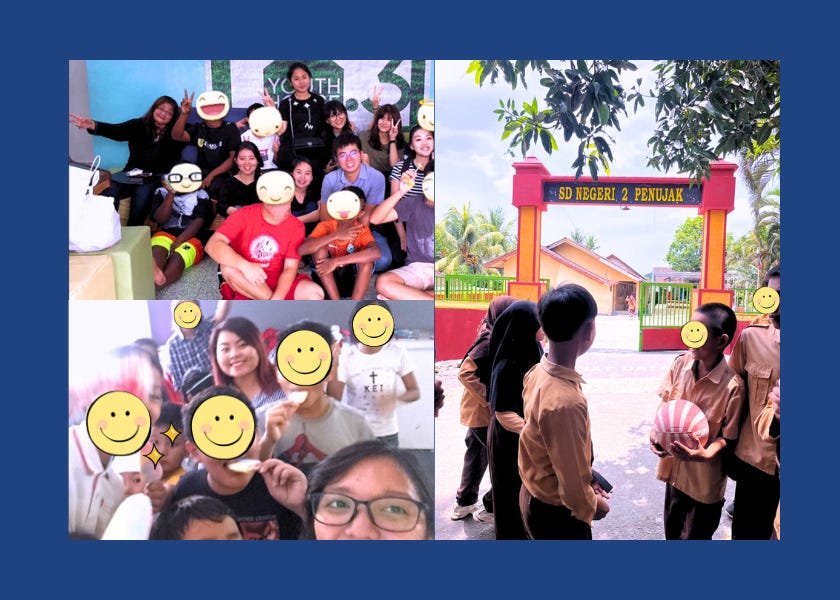
Back when I was living in Malaysia, I volunteered at an orphanage, teaching primary school children about the environment and why we need to care for it. Every Saturday. 10 am to noon.
Thanks to YouTube and ClimateScience.Org, I learnt how to carry out the class.
I softened the entry point, started with things they recognised, made the science age-appropriate, and made games out of it.
I couldn't tell if the students loved my class or just hanging out with me because I always came with games.
Most importantly, I couldn’t shake the feeling that something was missing. That the lessons weren’t connecting deeply enough for any real behavioural change to happen. So I kept adjusting the material. But I think it didn’t change much. I was stuck.
It took a completely different class, seven years later — in a flickering-light classroom in a school I’d never been to — for me to see what I missed.
It wasn’t that I was explaining climate wrong.
It was that I was starting with climate at all.

Let me go back a bit.
My father grew up in the remote, far Eastern part of Indonesia, West Papua, in the 60s.
Back then, Indonesia was barely on the map. Bali would probably be more associated with how British people pronounce “barley.” (Or at least that's how it'd sound like to me when I'm faking my British accent). And this part of Indonesia was even less so.
For context, I drove through Jayapura, the provincial capital of West Papua, in 2019 for a family affair. The main road, the one running next to the parliament building, was pitch dark at night. No street lights. Our headlights were the only source of light on the entire stretch.
And this was just seven years ago. Imagine what it was like during my dad's childhood. Well, actually, let me paint you a picture for you to imagine.
For school, he had one notebook, crumpled in the pocket of his school uniform. No bag. No shoes. He walked barefoot to school every day. And he still fondly shares this with us when reminiscing about his childhood.
Because underneath the modesty, his childhood was a lot of fun. After school, he'd fish by the sea or the river, or head into the forest to climb trees and pick fruit for a snack.
Life was simple and unhurried. The days stretched wide, and you filled them with whatever the land offers you. Full of surprises. Every day was an adventure.
I visited his hometown when I was 8 and experienced two weeks of this lifestyle. Which was super different from mine, who was raised in a town right next to Jakarta in the 90s.
Mornings in my dad's hometown meant chasing the neighbours’ chickens.
Afternoons meant petai leaf competitions. To play, you strip the smaller leaves from the stalk until only the stem remains. You tie it into a knot, find an opponent, hook the knots together, and pull. The knot that survives wins.
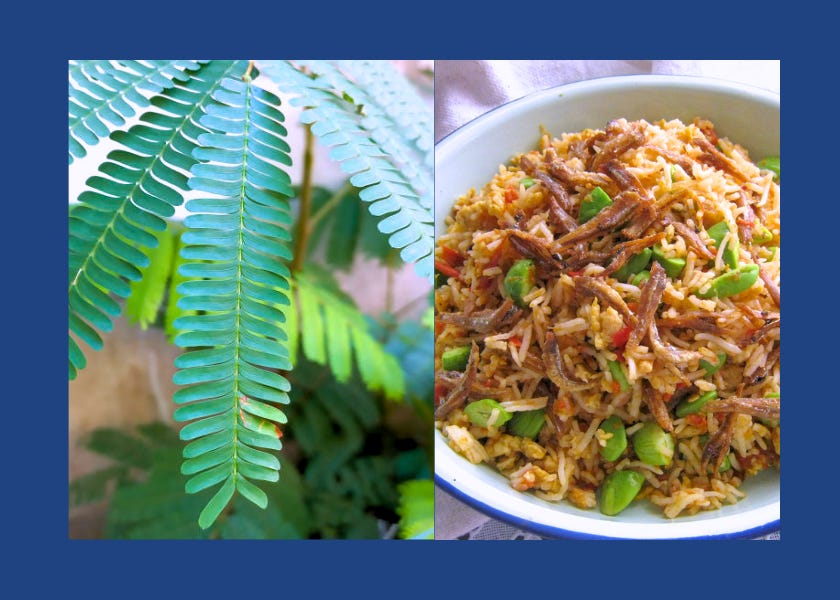
It's basically the wishbone game, except you make it yourself from something growing in your own garden.
Playtime wasn't Teletubbies playing on TV. It meant playing with water in the riverbank or swimming at the beach with my cousins.
I was only 8, but this had been imprinted as my core memory to this day. One that's full of laughter, zero agenda, and a new surprise every afternoon.
At this time, nobody explained to me that nature was worth caring about. I just spent enough time in it that it came naturally for me to feel the wonders of nature.
Arguably, my dad reinforced this value in me, quietly. Through encyclopaedias, he bought us that we’d read together, page by page, discovering the animal kingdom side by side.
As we turned into adults, whenever a WWF volunteer stopped us at the mall asking for a donation, he’d nudge us forward: “Go on. I grew up in the village. We owe it to nature.”
It's possibly also his way of avoiding an awkward conversation to say no to spending his dime on a stranger. In this economy, who could blame him?
But the message stuck. And his nudging worked as we would sign up to be a donor for causes we personally love. Yet, I just hadn’t connected it to anything yet.
I hadn’t realised that this closeness to nature was the whole reason I’d eventually spend almost my entire life savings to move to Spain and pivot my career into sustainability two years ago.
When I stood in front of a classroom, I taught facts. I never started with the feeling.
The gnawing, soft feeling that makes you stop and stare at the sky on a Tuesday just because it looks unreal.
I assumed the wonder of nature and caring for it would follow once children understood what was happening. Now I know it works the other way around.

As I now live in Spain, the itch to go back to teaching still lingers.
My Spanish is good enough to have a chit-chat with the bartender when I need to get drinks or get through daily errands. But to run a classroom? That would be a mission to embarrass myself, I thought.
I told myself I’d try when it improved. But the longer I waited, the more I felt its absence.
So when I went back to Indonesia last year, I knew I had to do it. I could do it in Indonesian, so that would solve the language barrier. I chose Lombok as a way to spend a weekend trip with my best friend while doing something meaningful together.
It’s a region already living with climate change: coastal erosion, disrupted fishing seasons, and waste piling up faster than the infrastructure can manage.
We raised 3.5 million rupiahs from my network (about USD 210). In dollars, it may seem like a small fund, but in Lombok, that's 35% above the monthly minimum wage there. It was enough to improve the school’s facilities and set up a basic waste-sorting system.
So the class was one part of the visit. The fundraising was another.
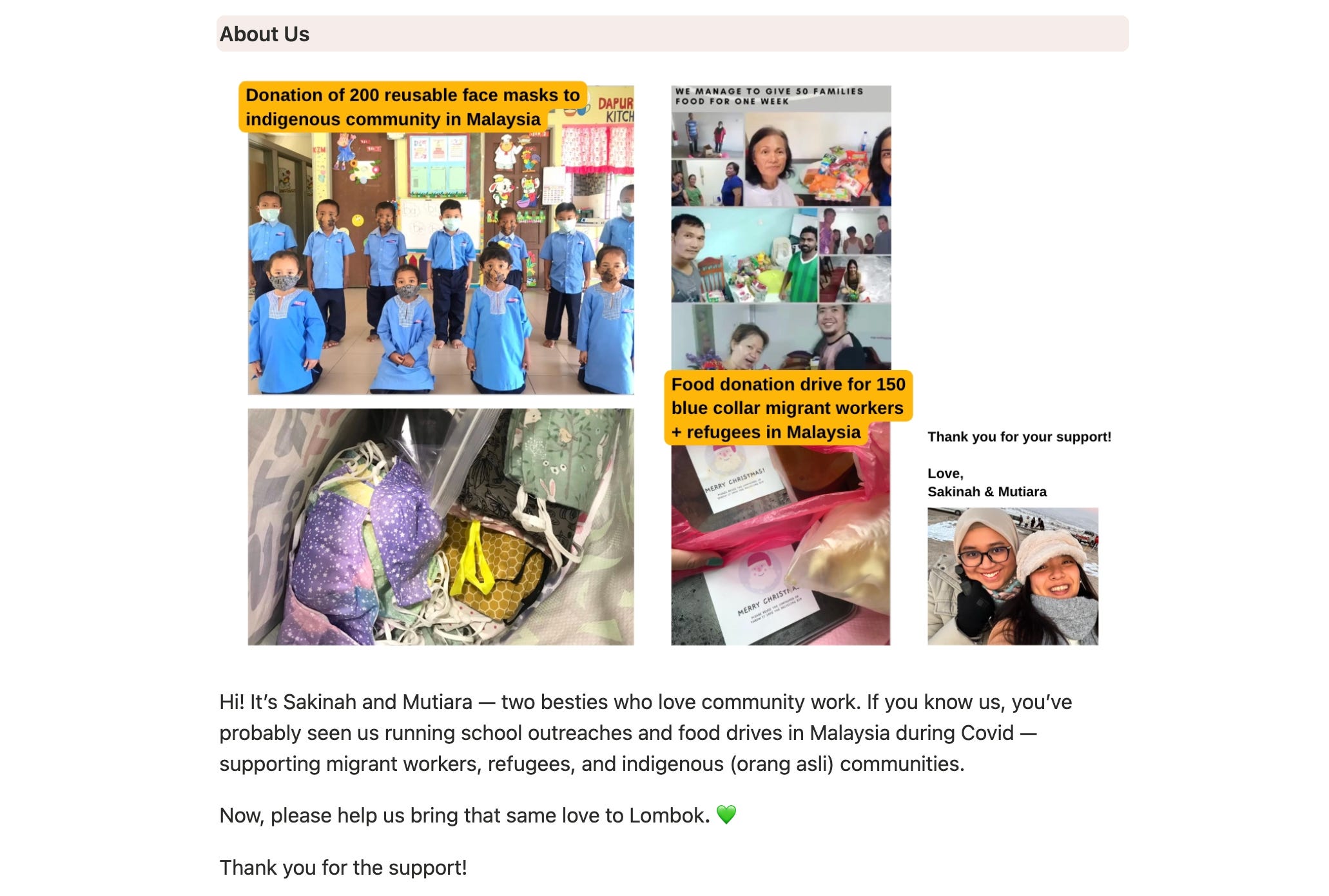
I've done this kind of fundraising a gazillion times before to know how to achieve the target. But the curriculum bit — I started having doubts in my own ability to do it.
As I was sitting with it, I came across Kate Howlett's article about the benefits of sitting on a park bench. Kate is a social ecologist who writes about the importance of nature connection based on her extensive research in her PhD about it. She argues that nature disconnection is the missing piece in understanding climate inaction.
To be honest, I’d heard versions of this before, back when I visited the towns of the Indigenous people in Southeast Asia. But this time, it clicked differently.
My instinct told me to write to her and ask for insights on how I can build my curriculum. And she wrote back!
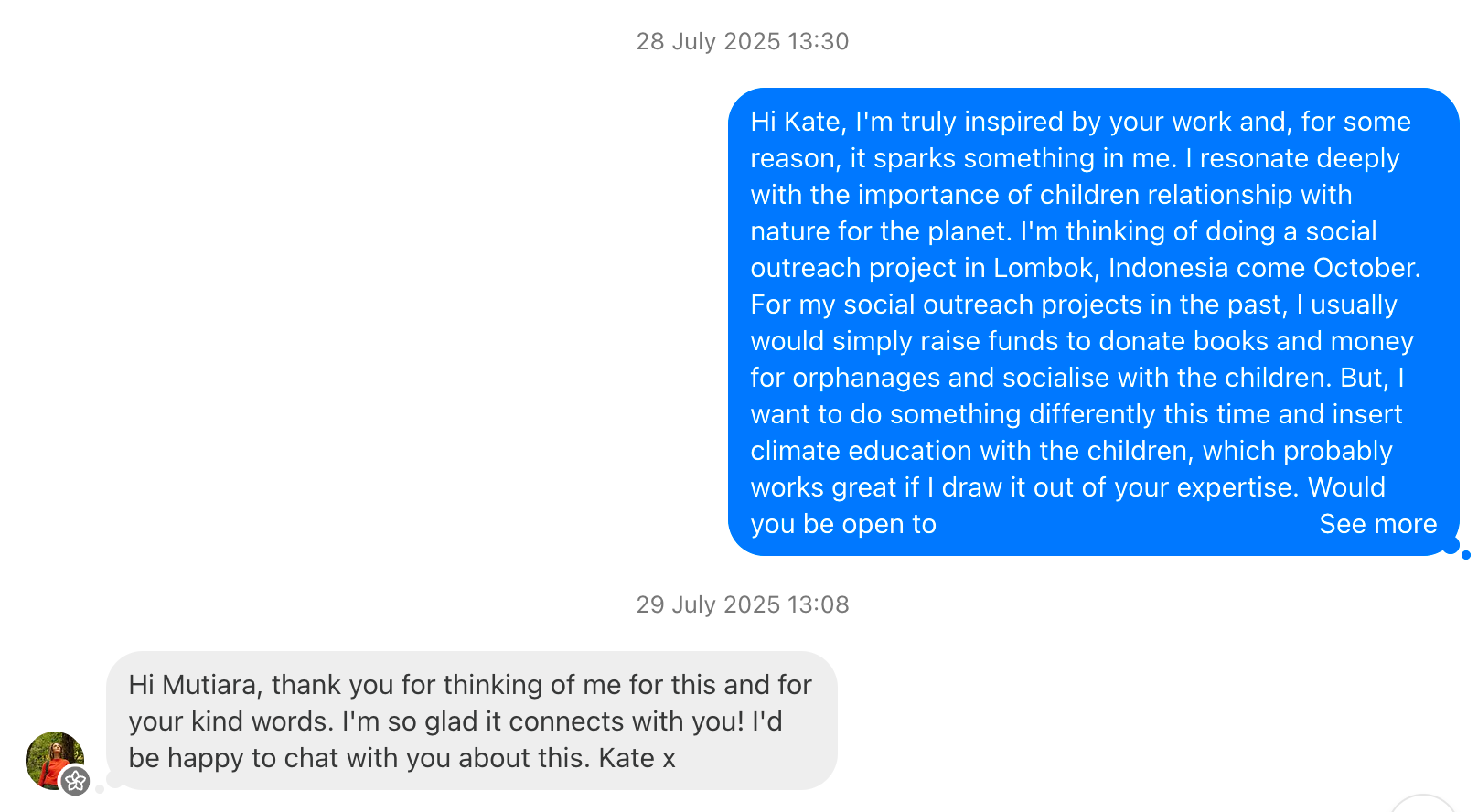
We got to talking, and she generously helped answer my burning questions.
Her answer was simple: in rural communities, children are already surrounded by nature — so don’t introduce them to it. Ask how they feel about it. Ask how they’d feel if it were gone. The attachment is already there. You’re not building it. You’re asking them to notice it.
Children have an almost instinctive sense of stewardship. It doesn’t need installing. It needs a question.
I sat down with it and went back to ClimateScience.Org to kind of tie this insight with what I'm familiar with.
And this time, I found out that ClimateScience.Org is backed by nature-based solutions research from Cambridge Zero — the sustainability arm of University of Cambridge. I hadn't realised that before. And coincidentally, that's also where Kate’s PhD is from!
At that moment, it felt like the universe was being slightly unsubtle to me. Truly embodying that this concept isn't new to me — I just hadn't made it front and centre. And that is the missing key that I've been looking for.
The point is the same: disconnection from nature may be a cause of the climate crisis, not just a symptom.
I had the “Bazinga!” moment. Time to put it into action
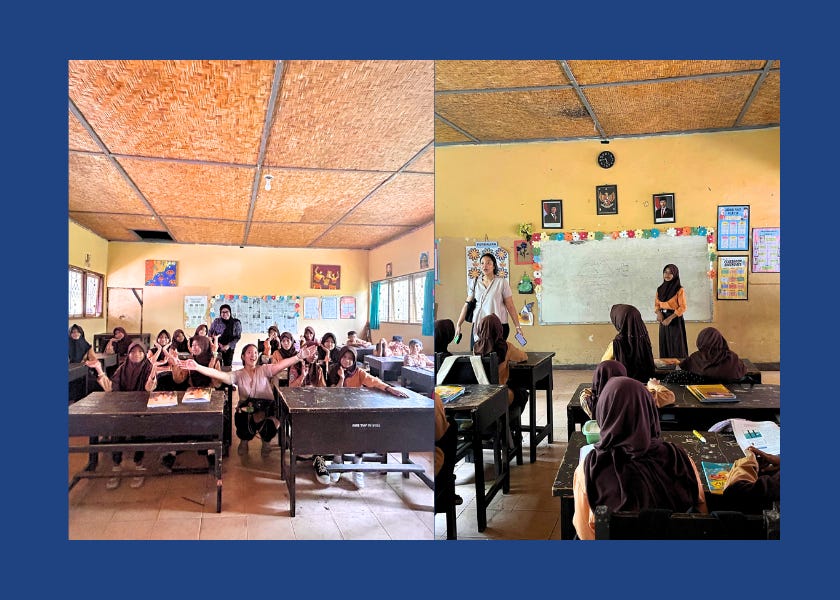
“What’s your favourite place in nature?”
That's how I opened the class this time.
And the answers rolled in quickly. The sea, a mango tree at their grandmother’s, the rice fields, and a river on the walk to school. I drew them all on the board with the help of one volunteer. Without me framing it, they’d already made a map of everything they loved.
Then they drew their favourite place and wrote three words about how it felt. When I asked how they’d feel if that place were damaged, the room went quiet. No, it was not the bored quiet kind, but the thinking quiet kind.
We shared a short story about Lombok’s changing landscape. A discussion that barely needed steering as it all flowed naturally. They had opinions. They’d always had opinions. Nobody had just asked them about this before. Kate was right.
We ended with short letters to the Earth. Some read theirs aloud. The room cheered each one. The energy kept on building up.
Then I told them about the waste-sorting facility we plan to have for the school. I asked if they would follow the rules.
Every single one of them cheered YES. It was a loud, resounding consensus. Immediate. No hesitation.
Comparing this to my time at climate diplomacy…
I spent time at the Global Plastics Treaty in 2024, working as part of the team shaping the process and negotiations for ASEAN. And I watched firsthand how some negotiations at INC-5.1 collapsed into a deadlock.
👉 Read our lowdown, simplified analysis of the Global Plastics Treaty in 2025
The countries divided, progress blocked, industry lobbying winning the room. Years of work. Brilliant, dedicated people. Still no binding agreement. That's climate diplomacy for you.
In this short initiative, spending half an hour with children who’d just been asked how nature made them feel, and the consensus was built unanimously and instantly.
If only uniting policymakers were as easy as this. But that's a very naive statement from me.
What I took away from Lombok was important to me. No, we didn't rewrite the policies in that province. But I also came to the reminder that even small things like this count as a change, too.
Change doesn’t always look like a signed treaty. Sometimes it looks like a classroom full of children who have just realised the river on their walk to school is worth protecting.
Some change begins quietly. With hope, curiosity, and willingness to do better.
It starts small. It starts with a feeling. It starts, as it turns out, exactly where I should have started all along.

😍 FREE STUFF ALERT!
If you’re curious about how I put this all together, or if you’re thinking of doing something similar, I’ve made the following resources available:
My simple fundraising page on Notion — I shared this on my Instagram Story and across any community groups I'm in (including chats with friends on WhatsApp)
Insights from Kate that formed the backbone of my curriculum.
The curriculum I created for the class in Indonesian and English. (Note: It's originally written in Indonesian, and I translated it using Deepl)
I’m sharing in the hope that it'll be useful for anyone looking to start small in their own community. I promise that the joy you get from seeing this through is something you’ll carry with you forever. ☺️
Or if you feel more compelled to talk about it further with me, connect with me on LinkedIn or grab a virtual coffee chat with me.
Lastly, shoutout to Kate Howlett for being a part of this. And shoutout to Substack for connecting us. And shoutout to YOU for being a part of this journey! 💙
P.S. Are you a business, organisation, or individual with circular ideas you’d like to share? Comment below or email hi@searcularity.com for a potential feature 👋🏼
 | A guest post by
|