

They were wrong. Curiosity didn't kill the cat
It just meant peeling back another layer of the onion. Messier, sure. But you get closer to something real.

Hello, everyone! It’s great circling back to you. 😊
This piece was shaped by a conversation we had with Chi, founder of Clean Earth Project.
Clean Earth Project makes cleaning products from pineapple waste. Started in 2019 as a reusables brand, they relaunched in 2025 as a B2B sustainable gifting business — turning what farmers throw away into powerful enzyme cleaners.
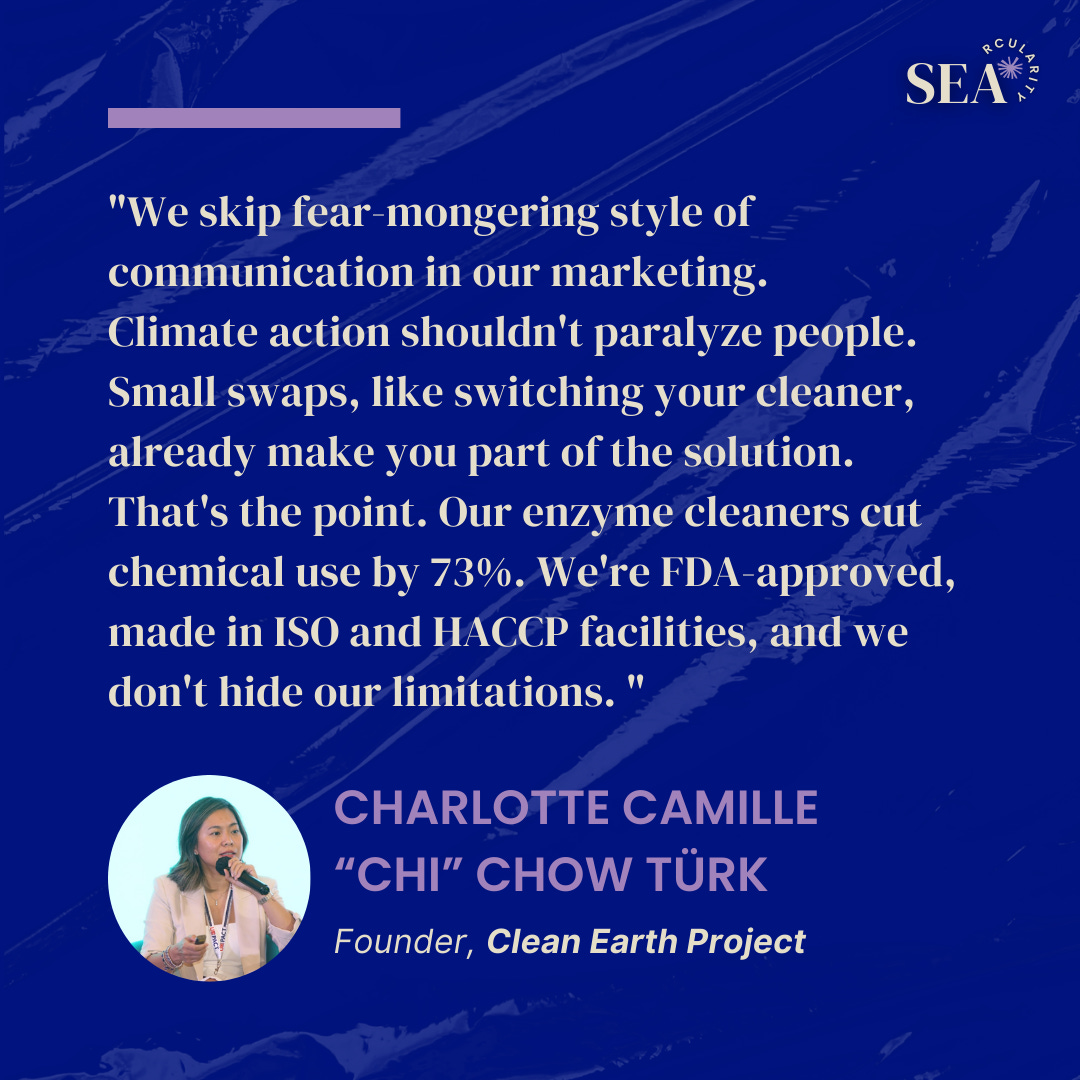
👉 Read our full interview with the Clean Earth Project team.
🔍 Check out non-toxic, circular cleaning products at the Clean Earth Project website, or follow along their promotions and updates on Tiktok or Instagram.Hi all - Mutiara here! 🙋♀️
It’s been a while. Like, properly a while.
I owe you an explanation for that. But I first owe myself some honesty about why I went quiet. And that took a while.
In that process of self-enquiry, I realised three things.
1️⃣ First: My journey in climate started when I was 14. The biggest river in my hometown, Bogor, Indonesia, was named the most polluted river in the world.
As my act of civic duty, I ran campaigns, got loud on social media (I only had 300 followers LOL), and rallied anyone I could to ditch single-use plastic every Wednesday.
2️⃣ Second: Fast forward to where I am now, driving communications strategies for impact organisations, that activist core never left in the all-winding journey.
3️⃣ Third: What did leave, somewhere along the way, was my voice.
When I thought that my curiosity killed the cat
It’s pretty frustrating when you’ve spent years doing “the right thing".
Wanting to and finally attending high-profile climate events, speaking out in campaigns, studying sustainability at a postgraduate level, scaling circular economy startups, sitting at climate diplomacy tables — and you slowly realise you don’t want to read another article about climate with a scary headline.
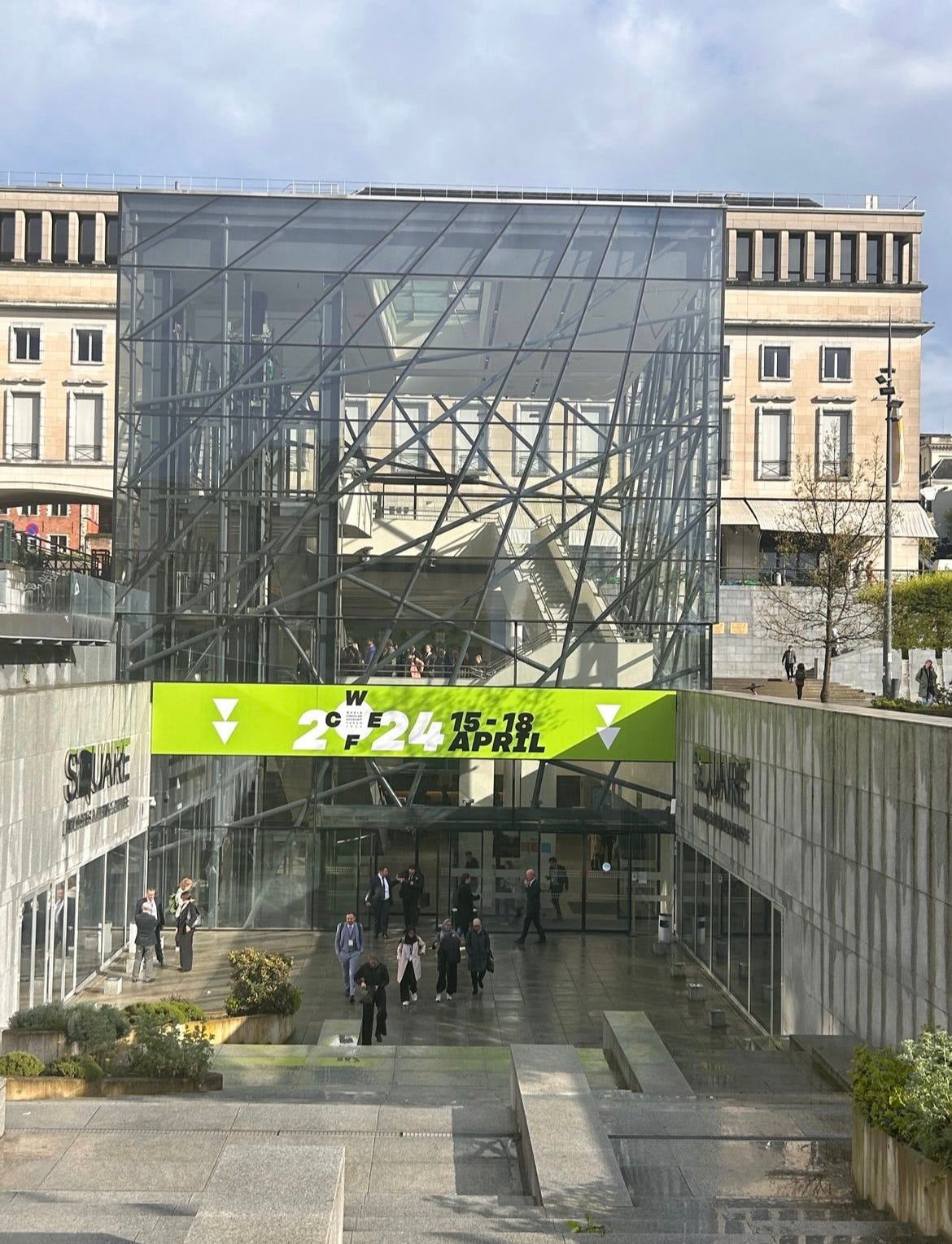
The data is real. Mass extinction is real. Climate breakdown is happening now, not in 2050. I know that.
But I started feeling like we were all spinning in circles. I'm sure we all felt that too.
Business as usual didn’t just carry on — it got hooked up to new forms of steroids.
And most of the “solutions” I kept seeing came from the same thinking that created the mess. New ways to control, to manage, to perpetuate the norm.
So I went quiet. I stopped writing for SEArcularity. Heck, I'd be lying if I told you I didn't think of quitting it.
I stopped posting online because I wasn’t sure I was saying anything worth saying anymore.
But, now I know I’m far from alone in feeling that.
Down the rabbit hole it went
Instead of forcing it, I let myself go through that uncomfortable phase of frustration and slowly go back to what made me feel alive.
I learnt about the psychology of trauma (Yes, I'm a psychology nerd).
Picked up trash from the sea when I was supposed to “relax” and “enjoy my holiday.”
Talked to strangers about their personal philosophy.
Experimented with gathering and the art of deep listening.
I met humans who are boldly reimagining and building safer, more equitable futures - not from boardrooms but from the ground.
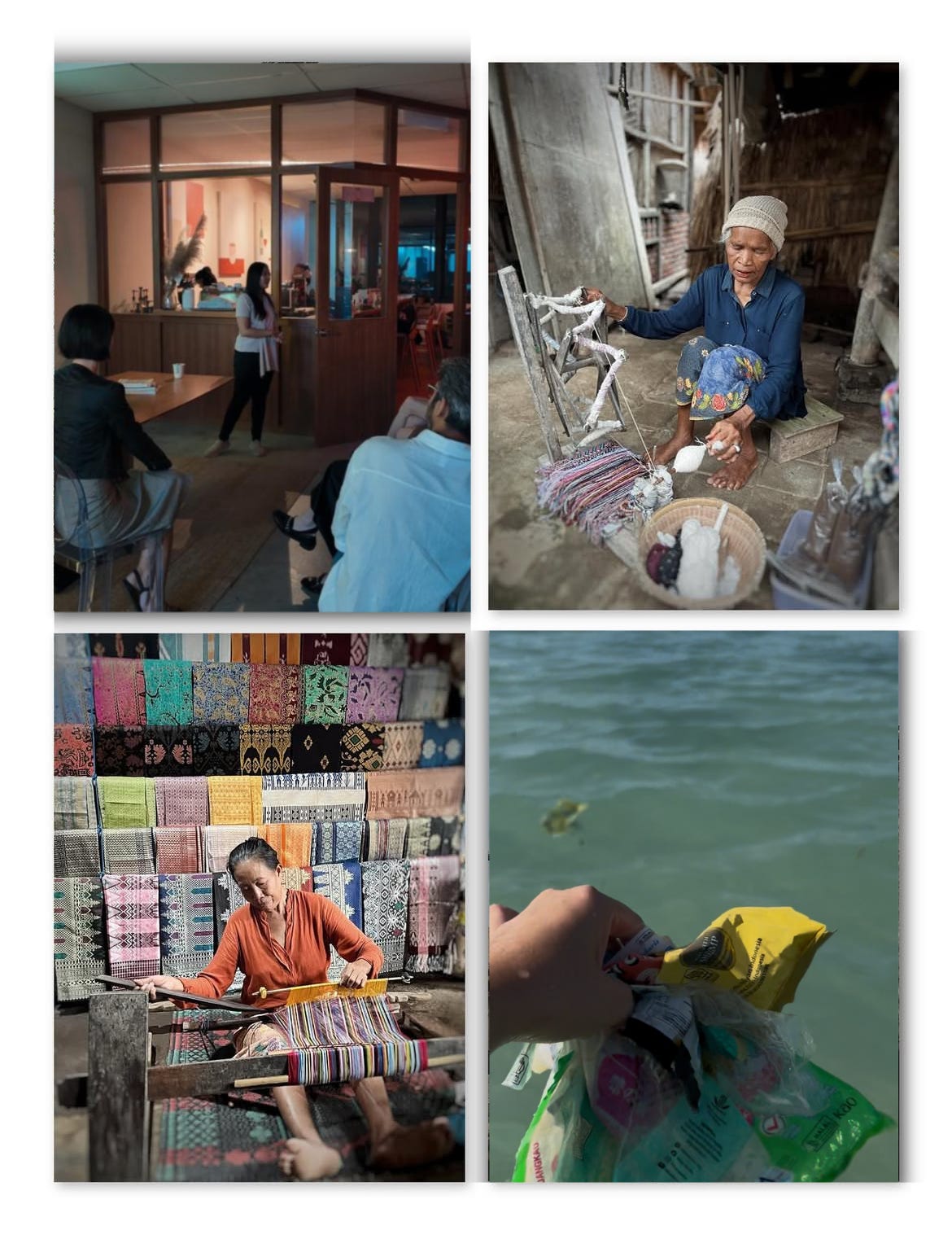
The biggest shift came from conversations with Indigenous people from different regions, and allies who’ve been doing this work long before “circular economy” became a term in European policy papers.
They gave me language for something I’d been feeling but couldn’t articulate:

“Underneath the climate crisis, there lies a relational crisis.”
Disconnected from nature. Our own nature. From each other. From the living world around us.
And if we don’t address that root, we keep spinning. New frameworks, same circles.
Having read and dissected numerous climate policies and witnessed them being rewritten again and again, this hit hard for me.
I know the way we’ve been communicating about climate is broken, but I never put two and two together.
Climate communications that we have today is a mirror of that disconnection.
It’s heavy on fear, light on feeling. Full of jargon, stripped of warmth.
When we put the gender lens, it's leaning too far into the masculine tone of communications.
Yes, it sounds smart. But it doesn’t move people to actually change how they live.
If anything, like what Chi has quoted in the beginning, it's paralysing.
And we're not interested in that kind of communication anymore.
We're more interested in balancing it with a feminine tone of communication that emphasises empathy, active listening, and relationship-building.
So here’s where SEArcularity goes now
We’re still your circular economy newsletter.
Still covering Southeast Asia - the region that practised circularity as a way of life long before anyone put a name to it.
We're still connecting what’s happening there with what we see here in Europe.
Danna and I are still writing this from Barcelona, still holding down full-time jobs, still doing this on the side because we believe in it.
But we’re stripping away the doom & gloom.
We’re writing from care instead of panic. From community instead of authority.
From the kind of energy that our older generations in Southeast Asia already knew - that you tend to things because you love them.
Not because you’re terrified of losing them.
If you notice the change in our logo, that's a sign of our change. It's intended for this reason.
It's championing the feminine energy from the two Southeast Asian women writing your favourite newsletter behind the screen. (Us 🙋♀️🙋♀️)
A room full of you
We celebrated our 1st year on Substack in October.
A year in, and we now have 232 subscribers.
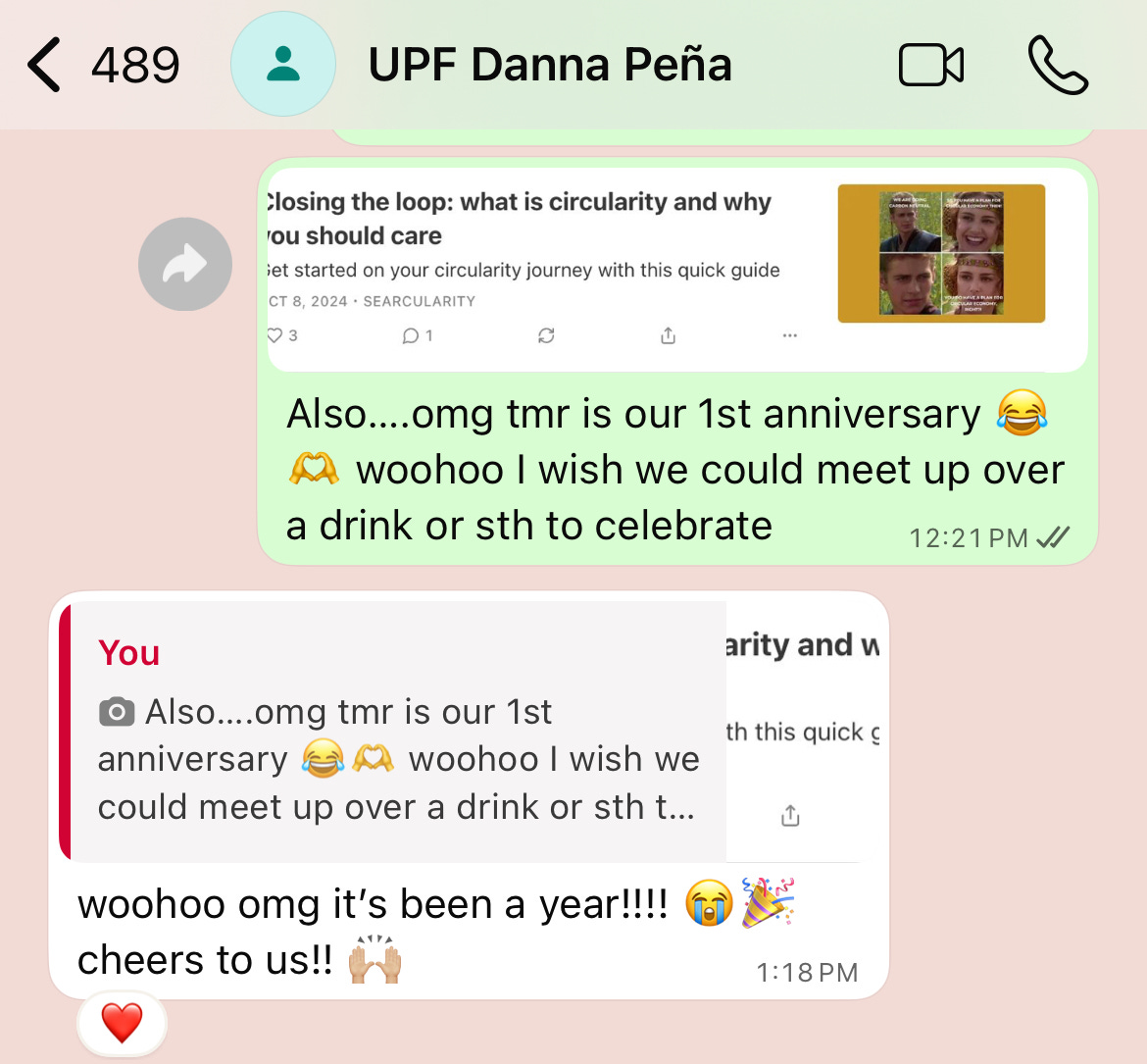
On paper, that’s small. But put all of you in one room, and you’d fill a hall.
That’s double the size of a not-so-intimate wedding I plan to have with my partner.
If I had to take you all for a treat, it would definitely bankrupt the heck out of me!
When you put that into perspective, this is actually a big crowd, eh?
And look at what this awesome crowd has already gotten us thus far.
We've partnered with Good On You to highlight sustainable fashion brands.
Danna got invited to be a speaker for a 1-hour seminar at her university about greenwashing in communications, with over 180 attendees consisting of students and professors.
I connected with many amazing creators in the field, including Kate Howlett from Natural Connection, who kindly helped me shape a climate awareness class for an underprivileged school back home in Indonesia. (A piece about this is coming up real soon!)
Together, we supported Vilgro, a social enterprise incubator in the Philippines, and helped their circular economy cohorts work on their comms.
Not to mention, we’ve been connecting with incredible writers and like-minded folks in the Substack community across the globe!
All from a newsletter we write between our day jobs.
Imagine what we’d do with more people in the room.
So yeah, we're staying in the ring
We don’t have all the answers. Our worldview has shifted, and it’s still shifting.
But there’s work to be done, and a lot of brilliant humans out there aren’t quitting.
Below this, we’ve got a roundup catching you up on everything you missed.
From now on, expect us back in your inbox weekly.
Same depth. Different energy.
More vibrant. More connected with our femininity. More grounded to Mother Earth.
A circular economy roundup while we were away (Oct 2025 – Feb 2026)
A lot has happened since we last wrote. Here’s what caught our eye.
😊 These will (probably) make your day
📜 Africa just dropped a continental circular economy plan. The African Union released its first-ever Circular Economy Action Plan, and the framing is interesting.
It’s less about waste management and more about stabilising jobs and rebalancing the power in global supply chains.
🏙️ Asian cities are teaming up on circularity. The Asian Circular Cities Declaration was launched at the Asia Smart City Conference 2025 in Yokohama. It’s a shared framework for cities across Asia to work on circular urban development together.
🌱 ASEAN is linking circularity to resilience and well-being. I find this a big win! Policymakers across ASEAN are folding circularity into trade agreements and economic resilience plans. Circularity is framed not as an economic common sense.
🇬🇭 Ghana is incubating circular innovators. Ho Technical University opened a new intake for its Piloting and Incubation Programme. If you know anyone building circular solutions in West Africa, this is worth flagging.
🤓 On the political side...
🇪🇺 The EU's Circular Economy Act has confirmed pilot measures to make it easier to move circular products and recycled materials across borders, and to bake circular design into product rules. Big if it actually lands.
🇬🇧 The UK delayed its circular economy strategy and rebranded it as a “Circular Economy Growth Plan” focused on jobs and resource efficiency. Ministers say they’re still “very committed.” We’ll see.
🌎 It gets interesting at the state level in North America. Maine, Oregon, and California are all pushing producer responsibility laws into implementation.
🎧 Two podcasts worth your commute:
All Things Circular — Launched in 2025, providing practical strategies for businesses wanting to start doing circular initiatives. A good entry point if your team is asking, “How do we begin?”
The Circular Coffee Break — Short episodes, conversational, featuring innovators across industries. Designed for busy people who want to learn without committing to a 90-minute lecture.
Do you have a business, organisation, or initiative that contributes to a circular economy? Connect with us on LinkedIn to start the conversation on how we can amplify your message and help you thrive!

Enjoyed reading this? Subscribe for free to receive our circular economy newsletters straight to your inbox! 📨
Hello from indonesia 🥺 i recently tried going into activism yet (nothing grand, just occassional volunteering) and i realized how quick i was to feel devastated by the state of the world, especially about climate change and gender equality.
Granted, i know these paths aren't meant to be easy, but sometimes i wonder if it's already too late? Not to mention, the government's lack of action only made my anxiety worse.
But then i saw videos from other climate scientists and comminciators, also fellow feminists, and how they dont give up despite having the same doubt and having to pause when it gets overwhelming. It brought me a sense of courage and hope. So i hope that you know that there are people out there who admires and feel inspired to change by your works! But of course, take breaks whenever you needed hehe
🙌🏼❤️🔥